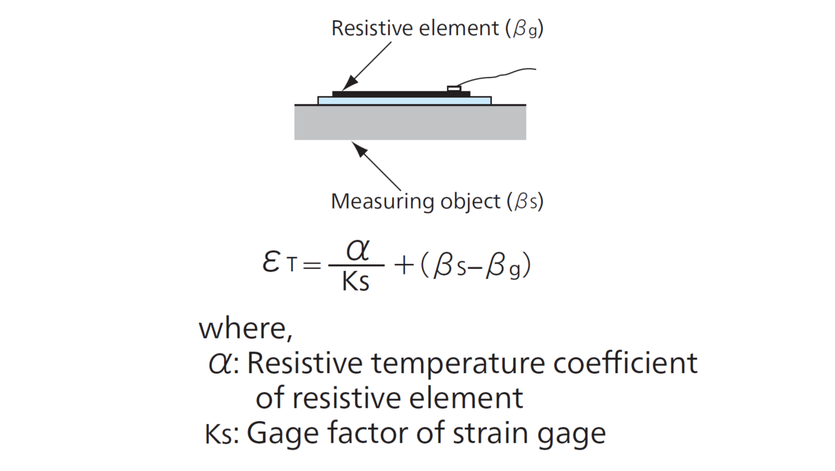


When receiving a temperature change, a strain gage bonded to a measuring object generates an apparent strain due to a difference in linear expansion coefficient between the measuring object and the resistive element of the strain gage, and a thermally-induced resistance change of the gage element. The SELCOM gage has a resistance temperature coefficient of the resistive element adjusted to match with the measuring object, thereby minimizing the apparent strain.
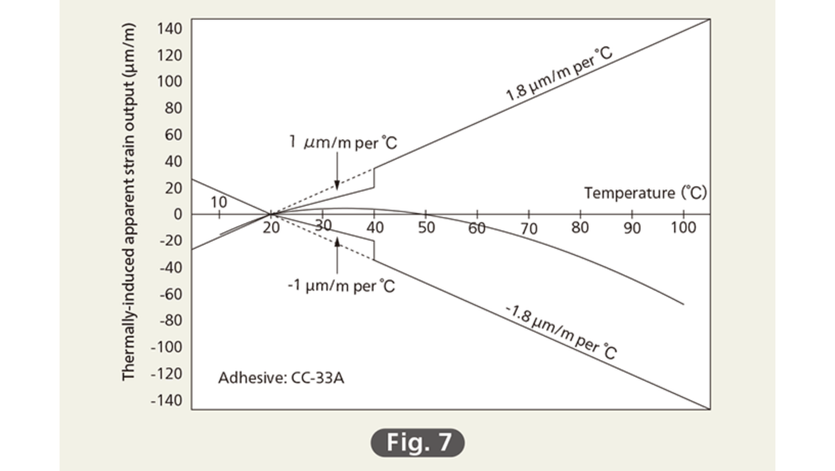
Kyowa's SELCOM gages have been adjusted so that, when they are bonded to suitable measured materials, the average value of the apparent strain in the self-temperature-compensation range is within ±1.8 μm/m per ℃* (representative value).
As shown in Fig. 7, the thermally-induced apparent strain of KFGS gages is within ±1 μm/m per ℃* in a temperature range of 20 to 40℃ in which they are most frequently used.
* Representative value. For details, see the "Thermal Output" data attached with the products.
Typical characteristic curve of thermally-induced apparent strain with KFGS gages
The measuring object and the resistive element of the strain gage have linear expansion coefficients βS and βg , respectively. The strain gage bonded on the surface of the object provides a thermally-induced apparent strain ε T per 1°C that is expressed with the following equation: