


FAQ: Measuring Instruments
ข้อมูลทางเทคนิค
Measuring Instruments
Product Selection
| Question | Answer |
| Do you provide any products that offer the best performance for field network? | The WGA-910A, WGA-680A, and WP-120A support CC-Link. The WP-120A supports EtherNet/IPTM. |
| What types of measurement instruments are there? | Primarily, there are four types of measuring instruments which are STRAIN AMPLIFIER : DPM-900B Series, CDV/CDA-900A, MCF-B etc. STATIC STRAIN MEASURING INSTRUMENTS : UCAM-80A etc. ACQUISITION INSTRUMENT for dynamic strain : PCD-400B Series, CTRS-100 Series, EDX-5000A etc. INSTRUMENTATION CONDITIONERS : WGA-680A, WGA-910A etc. |
| I want to measure press pressure with a load cell and transfer the data to the PLC via the AD conversion unit. What’s the optimum conditioner? I prefer one with pressure display and analog output. | Kyowa Electronic Instruments provides various conditioners. We recommend WGA-680A and WGA-710C for your case. See here for more information. |
| Tell me which measuring instruments support remote sensing. Tell me about also how to set the calibration factor when using a transducer supporting remote sensing. | Examples of measuring instruments supporting remote sensing are CDV-900A, WP-120A, and WGA-710C. When connecting a transducer supporting remote sensing to a measuring instrument supporting remote sensing, use the calibration factor on the Teat Data Sheet of the transducer. When using a measuring instrument not supporting remote sensing, the output drops due to the cable resistance, thus you need to use the calibration factor to compensate for the cable resistance. |
| Regarding WGI-400A, are the logic of the I/O ports of this product NPN or PNP circuits? I’m considering connecting a PNP input device to the WGI-400A output as an external device. | The logic of the I/O ports of this product are NPN circuits. See the instruction manual for more information. |
Principle
| Question | Answer |
| When using a strain gage or transducer, do I need a dedicated instrument? | You must have a dedicated Strain Measuring Instrument. Since the sensor side forms a Wheat Stone Bridge, in theory, it is possible to measure strain as long as you have a power supply to apply the excitation voltage and a voltmeter to measure the change in voltage (potential difference). When considering factors such as the power supply’s stability and S/N ratio and the potential difference of output voltage, it becomes unrealistic. The dedicated strain measuring instrument is designed with these factors in consideration, allowing for strain based accuracy adjustment for convenience. |
| Explain about Static Strain and Dynamic Strain | Slow phenomena changes are called Static Strain and fast changing phenomenon is called Dynamic Strain. |
| What is the difference between Carrier (AC) measuring instrument and DC Type Measuring Instrument? | There are two types of instruments for measuring the dynamic phenomena which are AC Power Bridge and DC Power Bridge. Characteristics of each are as follows AC type DC type a (DPM-711B) 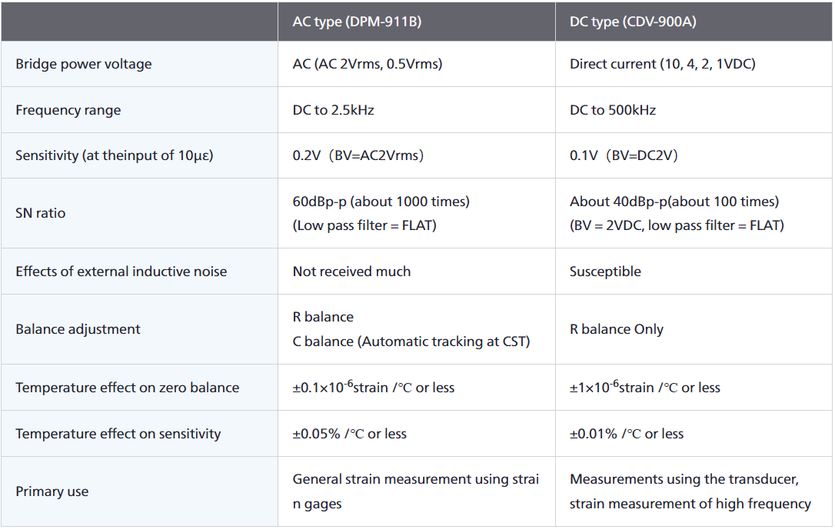 |
| What is the difference between Constant Voltage and Constant Current method? | DC system with a signal conditioner is commonly used to apply a constant voltage to the bridge and when you extend the cable connection, sensitivity is reduced by cable resistance. The sensitivity of the constant current method, on the other hand, does not decrease because it uses constant current, and according to the Ohm’s law (V=I・R), if the bridge resistant is constant, then the excitation voltage applied to the transducer remains constant. |
| What is simultaneous sampling and scanning? | There are two methods used when measuring multiple channels, the Scanning Method and Simultaneous Sampling method. This method has been adopted by static strain measuring instrument to measure the slow-changing strain. Simultaneous sampling method is a method to simultaneously measure all the channels at the same time, eliminating the time lag between channels. This method has been adopted for the acquisition instrument form measuring the dynamic strain time series changes in the strain of a moment. 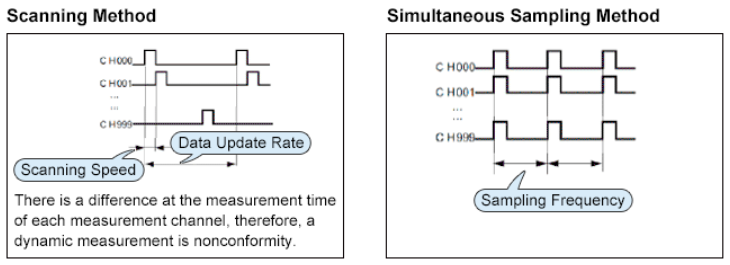 |
| Define the calibration constant | The calibration constant is the coefficient used to convert the strain value acquired by a strain gage transducer into physical quantity. In the measurement condition setting for both static and dynamic strain measurement instruments, you can input the calibration constant, allowing you to acquire data in physical quantity. |
| When I perform the measurement with the strain gage connected, should I output the strain value by setting the gage factor, 2, for the measuring instrument? Assuming I calibrate the data with the gage factor, is the calibration factor expressed as 2/(gage factor) = approximately 0.9? | The gage factor of the measuring instrument is fixed at 2. You can calculate the true strain (ε) from the measured strain (ε0) with the equation below. (ε)=2.00/Ks×(ε0), Ks: Gage factor of gage used. |
How to use
| Question | Answer |
| What do you do when there is noise | As basic measures there is single point ground. Single point grounding means to ground one of the series of the shielded part (Shield cable and metal housing), shielding it from external noise. Grounding 2 points from the same shielded series creates a potential difference causing the current to flow resulting in noise. Please see other solutions here. |
| Is there a method for combining two or more streams of binary data (ks2 files) recorded by a data recorder like EXD into a single file later on and further convert it into a CSV file? | The DAS-200A data analysis software offers a file coupling function. Two or more files recorded in a synchronous operation (master and slaves) can be coupled into a single file. |